
Local SEO NZ: What It Takes to Rank in Auckland, Wellington, and Christchurch at the Same Time
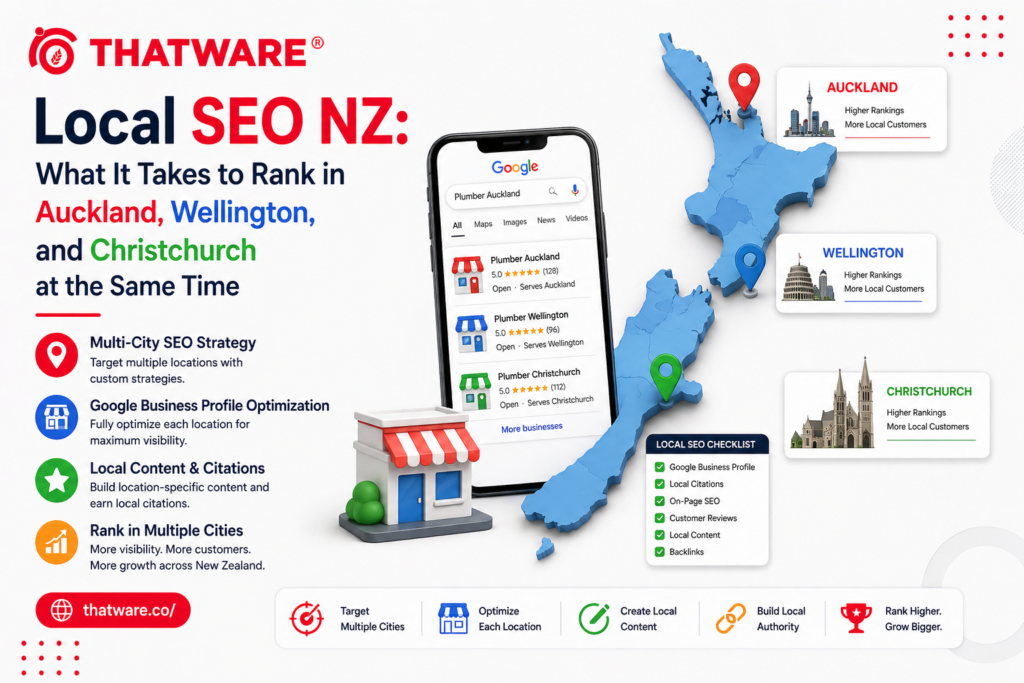
Seo agency new zealand
Running local SEO across multiple New Zealand cities simultaneously is a problem that looks straightforward until you’re actually doing it. The principle seems simple: optimize for each location, build local signals for each city, and maintain consistent brand presence across all three. The execution reveals that each city has its own competitive landscape, its own keyword patterns, its own business directory ecosystem, and its own audience characteristics that a single unified strategy doesn’t fully serve.
This is the challenge that any New Zealand business with genuine multi-city ambitions needs to address, whether they’re a service business operating nationally from multiple locations, a professional firm with regional offices, or a brand trying to build presence across the country’s main urban markets simultaneously.
Why Auckland, Wellington, and Christchurch Aren’t Just Smaller Versions of Each Other
The differences between New Zealand’s main urban markets matter more for local SEO than the size difference alone suggests.
Auckland’s search market is significantly larger than the other two, with search volumes roughly proportional to its population dominance. It’s also more competitive across most commercial categories. The density of businesses competing for local visibility in Auckland in most service categories means that the bar for appearing in the local pack is higher than in Wellington or Christchurch.
Wellington’s market reflects its capital city character. Government-related services, professional services, policy-adjacent industries, and the specific commercial ecosystem that a capital city generates produce search demand patterns that differ meaningfully from Auckland. Wellington consumers also tend to have high professional education levels, which affects content tone expectations and the kind of expert signaling that earns credibility.
Christchurch has been through significant economic and geographic change following the earthquake sequence, and its commercial landscape reflects that history. Certain industries have rebuilt stronger than before. Others are in different competitive positions than they were a decade ago. Understanding Christchurch’s current competitive landscape requires current market knowledge, not assumptions based on historical patterns.
Seo agency new zealand providers with genuine multi-city capability understand these differences and build city-specific strategies rather than applying a uniform national approach.
The Location Page Architecture
For businesses with physical presence in multiple cities, the location page architecture is the technical foundation of multi-city local SEO. Each location needs a dedicated page that provides genuinely unique, city-specific content: not just the address and phone number changed, but content that speaks to what’s specific about serving that city, the local team, the local projects, the local community involvement, the specific needs of customers in that area.
Generic location pages that duplicate content with only the city name changed are a common mistake. They create near-duplicate content issues and fail to provide the locally-specific signals that Google uses to validate genuine local presence. A Wellington location page that’s substantively different from the Auckland location page, because it reflects genuinely different things about the Wellington operation, performs significantly better.
Local schema markup for each location, with accurate NAP data, operating hours, and service area information, is the technical complement to the content work. Ensuring consistency between what the schema says and what the page content says is a basic but commonly missed requirement.
Building City-Specific Local Signals
Local citation building needs to be executed city-specifically, not just nationally. New Zealand business directories often allow city-level listings. Local newspapers and publications in Wellington and Christchurch provide local citation opportunities that national publications don’t. Local business associations and chambers of commerce offer directory listings that carry local relevance signals.
Review strategy needs to account for the fact that reviews are location-attributed. Reviews on the Auckland Google Business Profile don’t directly signal Wellington presence. Building review velocity on each city’s Business Profile requires active review generation specific to customers at each location.
Community involvement and local partnerships produce local signals that are harder to manufacture than directory citations but more powerful as authority signals. Being mentioned in local Wellington media coverage, sponsoring a Christchurch community event, contributing to Auckland industry associations, these activities build local entity recognition in ways that pure directory work doesn’t replicate.
The Keyword Variation by City
Keyword research for multi-city NZ campaigns needs to account for the fact that search volume and competition levels vary by city in ways that should influence content investment allocation.
A keyword with substantial Auckland search volume may have much lower volume in Wellington and Christchurch, suggesting that the content investment to rank for it nationally is justified by the Auckland opportunity but not the other cities individually. Conversely, some keywords have more balanced demand across cities.
Seo services new zealand programs doing multi-city properly run city-segmented keyword research that informs where content investment is most efficient for each city’s specific search landscape.
The Practical Management Challenge
Managing local SEO across three cities simultaneously requires more operational discipline than single-city programs. Review monitoring and response needs to happen across multiple Business Profiles. Citation consistency needs to be maintained across city-specific listings. Content updates for location pages need to be coordinated. Performance tracking needs to be segmented by city to understand which markets are performing well and which need attention.
This operational complexity is manageable with the right processes but requires explicit design. Brands that attempt three-city local SEO without the operational infrastructure to maintain it consistently tend to find that one or two cities get adequate attention while others drift toward inconsistency and underperformance.
The investment in building the operational infrastructure for proper multi-city management is worth making upfront. The alternative, discovering that your Christchurch listings are outdated and your Wellington reviews are going unresponded-to while your Auckland operation runs smoothly, is the outcome that deliberate process design prevents.
New Zealand’s cities are small markets individually. Collectively, a business with strong presence in all three has significant national market coverage. Getting the multi-city strategy right is worth the additional complexity it introduces.